Turning Problem Waste into Regional Opportunity
North East Waste (NE Waste) engaged Resource Hub to analyse waste audit data across four-member council facilities and deliver two days of intensive problem waste workshops – helping seven Northern Rivers councils move from a shared problem to a shared strategy.
The Problem with Problem Waste
NE Waste is a Joint Organisation representing seven councils across NSW’s northern rivers and hinterland — Ballina, Byron, Clarence Valley, Kyogle, Lismore, Richmond Valley, and Tweed. Like most regional councils in NSW, their member facilities were receiving a range of materials that fell into the category of ‘problem waste’: accepted at the gate, costly to manage, and with no straightforward path to diversion or recovery.
Seven waste types in particular were on the radar: wood, textiles, solar panels, plasterboard, expanded polystyrene (EPS), hard plastics, and mattresses. These materials are difficult to recover individually, and for regional councils without the tonnage or infrastructure of metro counterparts, finding viable solutions is a genuine challenge.
The financial reality sharpens the urgency. NSW’s regional waste levy sits at $103.80 per tonne — not as steep as the metro rate of $180.20, but enough that councils with their own landfills are acutely aware of how fast they fill void space with materials that could, with the right approach, be recovered. Building a new landfill is expensive. Extending the life of an existing one through smarter resource recovery is a far better outcome.
NE Waste had already done the legwork of conducting mini waste audits at four-member council facilities over the previous year — recording what fraction of mixed loads contained each of the seven problem waste types. What they needed was someone to make sense of the data, identify where the real diversion opportunities were, and help their member councils figure out what to do about it.
From Data to Direction
Resource Hub’s engagement had two distinct but connected phases: analysis and then workshopping.
In the first phase, Resource Hub worked through the audit data provided by NE Waste — analysing volumes, percentages, and the feasibility of introducing resource recovery initiatives for each of the seven problem waste types. The analysis included end market research to identify what options existed for each material, whether that was established recycling processors, emerging technologies, or regional collection and consolidation approaches.
For mattresses, for example, the options ranged from manual stripping and mechanical shredding through to engagement with Mattress Recycle Australia (MRA), which operates a national collection program — providing cages or bins at facilities, collecting and transporting to their Cootamundra processing facility. Each material was assessed on its own merits, with recommendations grounded in what was practical for regional facilities to implement.
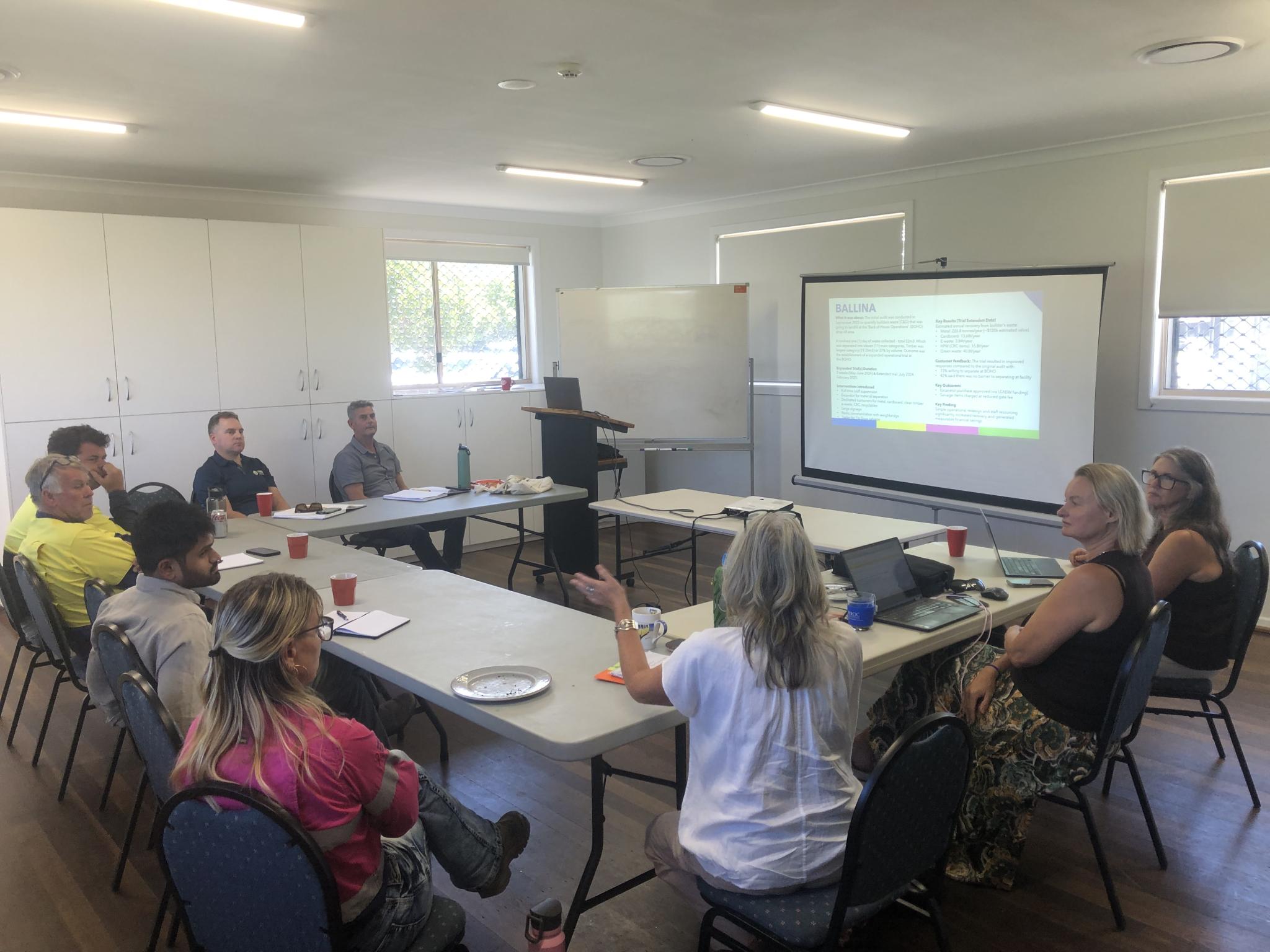
The second phase brought the findings to life. Resource Hub facilitated two full days of workshops with representatives from all seven member councils in attendance. The sessions included:
- Presentation of the audit findings with graphical analysis of problem waste volumes across the four audited sites
- Diversion opportunity recommendations for each of the seven waste types, including feasibility and end market options
- End market research outcomes, including technology options for councils interested in on-site processing
- Operational workshopping with individual councils — working through site-specific challenges and identifying where regional collaboration could deliver better outcomes than going it alone
- Exploration of regional partnership opportunities, including shared infrastructure, negotiated gate fees, and consolidated transport arrangements
The workshop format was deliberately collaborative. Rather than delivering a report and walking away, Resource Hub structured the sessions to get council representatives talking to each other — sharing what they had, what they’d tried, and where they needed help. That conversation is where the real value emerged.
Every Council at the Table
Every single member council turned up to the workshops and engaged with the process. For NE Waste, that level of participation was itself a significant outcome — getting seven councils actively workshopping a regional resource recovery strategy together is no small thing.
What emerged from those conversations was the beginning of a regional approach to problem waste. Councils identified where existing infrastructure could be leveraged across the network, with some facilities positioned to act as material-specific processing or consolidation hubs for neighbouring councils — creating the kind of economy of scale that makes recovery financially viable at a regional level.
The workshops also had a knock-on effect beyond the room. NE Waste subsequently secured grant funding to progress the next phase of work identified during the sessions — a detailed operational mode and capacity analysis to assess how a regional problem waste recovery network could practically be configured and operated.
In the time since the workshops, NE Waste has also reached out to Resource Hub asking whether the slide decks developed for the project could be used in other workshops and presentations they’re delivering across the region — a practical indicator that the content hit the mark.
A Regional Problem Needs a Regional Solution
Problem waste is called that for a reason. These materials are genuinely difficult to manage — bulky, low in value, and without the economy of scale that makes recovery viable in isolation. For a single regional council trying to solve its mattress or EPS problem on its own, the numbers rarely stack up.
But when seven councils approach it together — sharing data, infrastructure, transport logistics, and processing capacity — the picture changes. The work Resource Hub did with NE Waste demonstrated that regional collaboration isn’t just a nice idea; it’s the mechanism that makes resource recovery financially and operationally feasible for councils that would otherwise be stuck sending problem waste to landfill.
This project is replicable. Any joint organisation or group of neighbouring councils grappling with the same problem waste types can take the same approach — audit the data, analyse the options, get the right people in the room, and start building a strategy that actually works at regional scale.